
.jpg)
Blogs
Packing Cube Price Guide: Cost Factors Every B2B Buyer Should Know
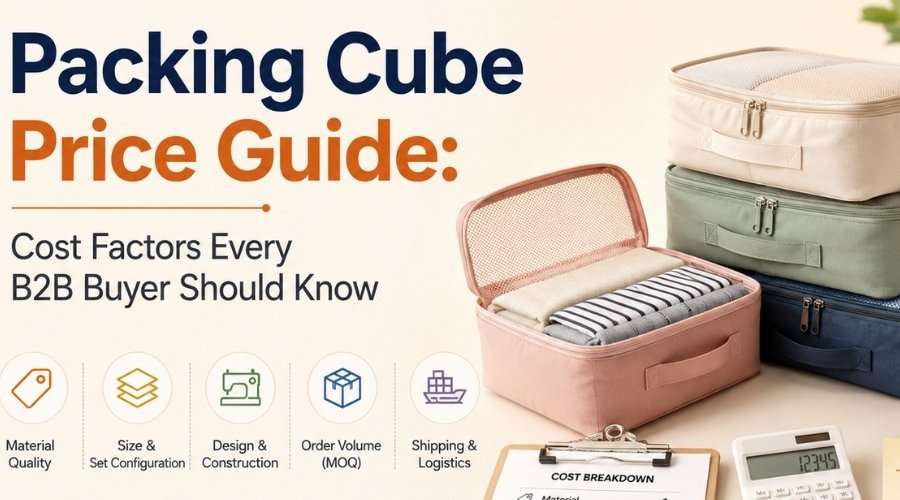
A packing cube has a simple construction. Zipper. Fabric. Four seams and that is all. But here’s what procurement pros learn the hard way: a $0.50 variance in unit cost on a 10,000-unit order is $5,000 straight off your margin. That amount is not peanuts but enough to generate presence through a marketing campaign or a yearly bonus for the staff.
The global packing cubes market has a positive demand outlook and consists of many brands competing for shelf space. But the price you pay per cube isn't set by market forces alone. It's set by choices you make or fail to make during sourcing. This guide breaks down exactly where those costs hide. No vague advice. Just the data and tactics you need to negotiate like you've been doing this for years.
The Materials: Where 60% of Your Cost Resides
Visit any factory and one thing that you will notice immediately are walls of fabric swatches. They look similar and feel similar. But their price tags tell a different story. Material isn't just a line item. It's the foundation of your product's story and your margin.
Contact Our Experts for Bulk Packing Cube Orders
The Fabric Quality Tiers
Entry-Level: Polyester or 210D Nylon
Cost range: $1.80–$2.80 per unit FOB Asia
These fabrics work for basic travel cubes. But camping gear demands abrasion resistance—zippers rubbing against tent poles, cubes stuffed into overloaded backpacks. Cheap fabric pills. It tears. And returns eat your margin faster than any material premium ever could.
Mid-Tier: Ripstop Nylon (400D–600D)
Cost range: $3.00–$4.50 per unit FOB Asia
Ripstop weaves are tear-resistant and the threads have a reinforcing grid that stops tears from unraveling the whole fabric. This special fabric is the industry standard for packing cubes made for camping and outdoor adventure trips. Camping customers punish their gear and ripstop is made to survive that.
Premium: Cordura or Ultra-PE
Cost range: $5.50–$9.00+ per unit FOB Asia
Cordura, originally developed for military applications offers extreme abrasion resistance. Ultra-PE (think Dyneema) is lighter than nylon but stronger than steel by weight. These are for premium boutique brands or technical alpine applications where every gram matters.
So what should be your material sourcing strategy? Match the fabric to the customer's actual use case. Weekend campers don't need Ultra-PE. But if you're selling to hardcore backpackers who expect gear to last a decade, then opt for higher-end tiers that can handle the harsh use.
Sustainability Fabrics
Every procurement pro is hearing about sustainability now. Here's what the trade data actually shows.
GRS-Certified Recycled Materials
• Premium range: 8% to 25% higher than conventional equivalents
• Recycled polyester (rPET): The smallest premium at 8–15% above virgin polyester
• Recycled nylon: A steeper premium at 20–30%
• Recycled cotton: The most expensive at 20–35% (frankly, not ideal for camping cubes anyway)
The operational costs behind these premiums are real: segregated production lines, dedicated storage, third-party audits, and transaction certificates for every shipment. A GRS-certified factory isn't just using different materials. It's running a parallel supply chain.
But here's what the ROI data shows: Brands using GRS-certified materials report 12–18% higher conversion rates online and can command 8–15% price premiums at retail. The material costs more. But the product sells better.
Strategic question: Is your retail partner demanding sustainability credentials? If yes, bake them into your specification before quoting. Retrofit costs triple what upfront planning costs.
Labor & Manufacturing: Where Your Money Really Goes
Keep in mind that you are not just paying for fabric, you are also paying for hands that cut, sew, and inspect. And those hands cost different amounts depending on where they're located.
China: The Incumbent
• Labor cost: Here, you will get a budget-friendly rate that suits high-volume runs.
• Tariff reality: Tariffs on Chinese goods remain in effect through 2025, adding 7.5% to 25% depending on the category.
• Best for: Orders above 10,000 unit
China's manufacturing infrastructure is top-notch and unparalleled. All the components of the packing cubes, from raw material to zippers and webbing, are within a few hours' drive so production cost will be quite inexpensive. But the downside is tariffs and geopolitical risk is real and quite unavoidable. Smart buyers use China for volume but maintain alternatives.
Vietnam & Cambodia: The Middle Ground
• Labor cost: Here, you will get a budget-friendly rate that suits high-volume runs.
• Tariff reality: Tariffs on Chinese goods remain in effect through 2025, adding 7.5% to 25% depending on the category.
• Best for: Orders above 10,000 units
Vietnam's textile sector has matured over the years and nowadays, factories located there can match the Western quality standards. The trade-off? Less vertical integration and zippers and webbing may still come from China which means a higher production cost and less control on quality.
Portugal & Mexico: Nearshoring Premium
• Cost premium: 20–30% higher FOB than Asia
• Lead time advantage of 2–3 weeks versus 6–8 weeks from Asia if your customers are from US and Europe.
• Best for: Small runs (under 2,000 units), rapid restocks, and brands marketing
Nearshoring isn't cheap. But shorter supply chains mean less working capital tied up in inventory. If your cash flow is tight, paying more per unit for faster turns can make financial sense.
Understanding Labor Cost Breakdown
Here's how factories calculate your price:
sewing minutes × regional hourly rate × overhead factor.
A simple cube with one zipper and no dividers might take 4–6 minutes to sew. But that is just the basic product that has low demand. A quality camping packing cube product that delivers an adequate margin consists of internal dividers, mesh pockets, and a second zipper. That takes at least 10–12 minutes to make. That difference of 6 minutes adds up across 10,000 units.
The important question to ask yourself: Does your design need all those internal features? Or are you paying for complexity your customer doesn't value?
The Hidden Costs: NRE, Tooling, and Testing
Here's where first-time buyers get blindsided. The unit price looks great. Then the invoice arrives with four-figure line items you've never seen before.
Tooling and Molds
Custom components cost money to create. That custom zipper pulls with your logo? The injection mold costs $500–$2,000. The proprietary buckle? Another $800–$1,500. The shaped mesh panel that fits your brand's aesthetic? You guessed it.
The key question: "Is tooling amortized over the order quantity or billed separately?"
Some factories spread tooling costs across your first order (raising the per-unit price). Others bill them upfront. Neither is wrong. But you need to know which model you're dealing with before comparing quotes.
Sampling Rounds
You'll pay for samples. That's normal. What matters is what kind of samples you're getting.
• Proto-sample: Quick-and-dirty, often using available materials. Good for testing fit and form. Cheap.
• Pre-production sample: Uses final materials, final components, final colors. This is your quality baseline. Not cheap but skipping it is gambling with your entire order.
Testing Standards
Camping gear faces abuse. Your packing cubes should, too.
Industry-standard tests include:
Abrasion resistance (ASTM D3884): This measures how many rubs it takes before fabric undergoes significant wear.
Tear strength (ASTM D2261): This test determines the fabric strength by measuring how much force is needed to rip a seam.
Zipper cycle testing: How many opens and closes before failure?
Lab testing costs $300–$800 per test, depending on the standard. But here's the math: a single quality dispute costs thousands in shipping, replacement units, and reputational damage. Testing is insurance and it’s cheap insurance at that.
MOQs and Economies of Scale: The Volume Game
Factories love volume. Volume keeps their lines running, their workers busy, their cash flow positive. They’ll reward you for it.
Standard MOQ Ranges
- Small factory: 500–1,000 units per color/style
- Mid-tier factory: 1,000–3,000 units per color/style
- Large vertical factory: 3,000–5,000 units minimum, but lower per-unit pricing
But a vital thing to remember: MOQs are negotiable, especially if you’re a new customer with growth potential. Factories bet on repeat orders. Your first order might push their MOQs. Your second and third won’t.
The Mix-and-Match Question
“Can I combine colors to hit MOQ?”
Most factories will allow this. But they’ll also charge a slight premium for managing the complexity. A better question: “What’s your MOQ per SKU versus per total order?” That opens the conversation.
Volume Pricing Tiers
Based on current trade data, here are realistic FOB Asia price tiers for a mid-range ripstop nylon cube (one size, standard construction):
|
Volume |
Per-Unit Price |
Total Cost |
|
1,000 units |
$4.50 |
$4,500 |
|
5,000 units |
$3.20 |
$16,000 |
|
10,000 units |
$2.75 |
$27,500 |
The sweet spot for freight efficiency is typically 5,000–7,500 units. That’s roughly what fits in a 40-foot container without wasting space. Below that, your freight cost per unit climbs. Above that, you’re paying for air unless you can fill multiple containers.
Freight & Logistics: The Variable That Breaks Budgets
You’ve negotiated the unit price. You’ve signed the contract. Then the freight invoice arrives, and suddenly your margins look very different. Freight isn’t an afterthought. It’s a cost center that needs active management.
Incoterms in Plain Language
EXW (Ex Works)
This means that the buyer is responsible for the transportation once the cubes leave the factory door.
Risk: You have to pay for export clearance, trucking to port, and everything else which is a lot of hassle. It also means more effort in finding reliable logistics agencies.
Suitable for: Experienced importers with their own logistics partners.
FOB (Free on Board)
According to these freight terms, the factory loads goods on the vessel at the origin port. You take care of the risk and cost from that point.
Risk: Import clearance and last-mile delivery is your responsibility.
Suitable for: Most mid-volume importers.
DDP (Delivered Duty Paid)
Supplier handles everything—including duties, taxes, and delivery to your door.
Premium: 20–30% higher than EXW pricing.
Best for: New importers or anyone who wants predictable landed costs.
Packaging Costs: The Silent Margin Killer
Retail-ready packaging costs real money. A simple polybag: $0.05–$0.10 per unit. A custom retail box with your branding: $0.80–$1.50 per unit.
The strategic question to ask here is ‘Does your distribution channel require retail packaging?’ If you're selling through REI or similar retailers, yes. If you're selling DTC and shipping in cartons, polybags are fine. Don't pay for packaging you don't need.
Procurement Checklist
Before Quoting:
• Confirm fabric type and denier (get it in writing)
• Specify sustainability certifications if required (GRS, bluesign, etc.)
• Clarify whether tooling costs are amortized or separate
• Define testing standards (abrasion, tear strength, zipper cycles)
During Negotiation:
• Get MOQs per SKU and total order in writing
• Request a DDP quote to understand landed cost
• Ask about packaging costs
• Confirm payment terms and whether better terms get better pricing
Before Production:
• Inspect the pre-production sample (don't skip this)
• Verify certifications match what was promised
• Lock in freight pricing or budget for volatility
Conclusion
Packing cubes may look simple, but the cost drivers behind them are anything but. Fabric choice, labor hub, tooling, testing, freight terms, and packaging all stack up to shape your landed cost. Ignore them, and you’ll watch margins evaporate.
The procurement pros who succeed in the market don’t chase the lowest quote. Their strategy is holistic and involves controlling variables, negotiating with clarity, and planning for scale.